

How Does Magnetic Coupling Work?
Magnetic Coupling (MC) is a type of coupling that transfers torque between two rotating shafts, such as those of motors and pumps or fans.
Unlike conventional couplings that rely on mechanical connections, MC transmits torque in a non-contact manner through magnetic fields.
The MC provides the same core advantages as the MSR(Magnetic Speed Regulation), minus speed regulation. With its much lower cost, it is the ideal replacement for conventional mechanical couplings where speed control is not required.
The Mechanism of Magnetic Torque Transfer
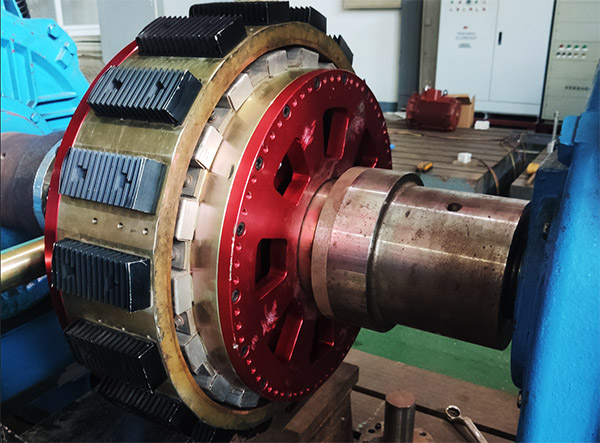
Magnetic drive is a revolutionary torque-transfer technology that transmits power through an air gap without any mechanical connection between the motor and the load.
A conductor rotor is mounted on the motor shaft, while a permanent magnet rotor is installed on the load shaft. When the motor drives the conductor rotor to rotate, it cuts through the magnetic field lines of the magnet rotor, generating eddy currents. These eddy currents, in turn, create an induced magnetic field that interacts with the permanent magnet’s field. This interaction achieves contactless torque transmission between the motor and the load.
This non-contact method of power transmission offers numerous advantages, including soft start capability, inherent overload protection, significant vibration and noise reduction, and maintenance-free operation.
The Mechanism of Soft Start
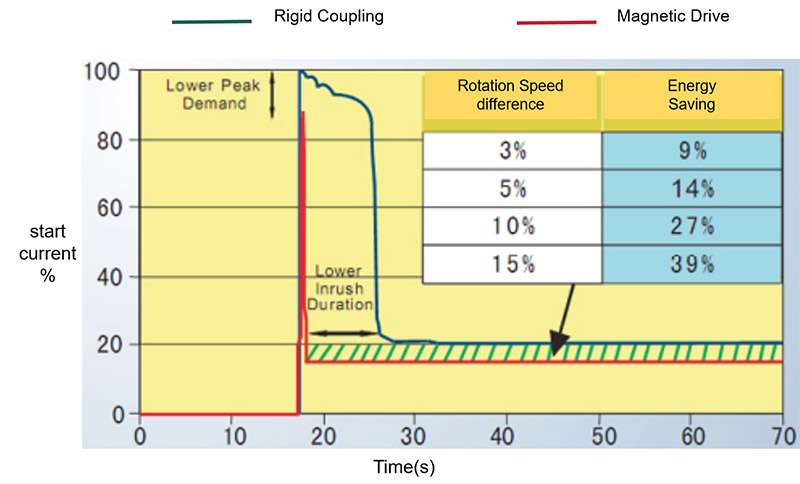
This oscilloscope capture compares the startup waveform of a 200kW high-voltage motor under load. The blue waveform corresponds to operation with a mechanical coupling, while the red one shows the performance with a magnetic coupling.
The magnetic coupling results in a significantly lower peak inrush current and a greatly reduced startup time. Therefore, it effectively protects both the motor and the driven equipment from startup stresses. Furthermore, it enables a soft start functionality, allowing the motor to start under minimal load and gradually accelerate to full speed.
These features collectively contribute to a extended service life for both components.
Non-contact Merits

With its unique non-contact torque transmission, MC delivers unmatched advantages for industrial applications:
Up to 81% vibration reduction – extending the service life of both motors and driven equipment;
Truly maintenance-free – no friction, no wear, and a reliable 20-year lifespan that cuts down operating costs;
Zero spare parts required – a simple design eliminates the need for periodic replacements and oil lubrication;
Built-in soft start and overload protection – ensuring smooth operation and safeguarding your equipment.
MC provides a smarter, cleaner, and more cost-effective solution for long-term industrial performance.
MC Is Ideal For
1. High coupling maintenance costs
- The need for manpower, oil, and spare parts inventory, as well as their periodic replacement, makes the maintenance cost of mechanical couplings very high.
- MC is maintenance-free, offering clients unmatched reliability and cost efficiency.
2. Soft start and overload protection
- MC allows the motor to start under minimal load and gradually accelerate to full speed, achieving a soft start.
- When overloaded, MC rapidly reduces the magnetic torque between the motor and the load to zero, thereby protecting the motor from damage.
3. High levels of vibration and noise
- MC can reduce vibration by up to 81%, which greatly extends the service life of both motors and driven equipment.
4. Fast and easy reform
- With a high misalignment tolerance of 2-3 mm, the MSR simplifies the retrofit of existing mechanical couplings. This upgrade sometimes can be completed in one day.
A typical case study demonstrating the merits of our Magnetic Coupling (MC)
The client is a publicly listed cement company that installed our 1.8MW magnetic coupling between the motor and the ore crusher.
Previously, due to the crusher’s significant vibration, the mechanical coupling frequently failed. The European supplier of the mechanical coupling required the client to return the product to its plant for repair, resulting in very high repair costs.
After adopting our magnetic coupling—which costs even less than a single repair—the failures were completely eliminated. The MC has been operating reliably and is entirely maintenance-free.
Encouraged by these results, the client is now planning to replace all similar mechanical couplings across its plants, including those in Turkey and Portugal.